
Ladataan...
Kirjaspotti Hamina
Raatihuoneentori 16, 49400 Hamina
Avoinna ma-pe klo 9-17
salpakirja@gmail.com
050 339 5724
2001 • SKS • Nidottu, pehmeäkantinen
Hinta:
6,00 €
Saatavilla:
2 kpl varastossa
Lähetetään 1-3 arkipäivässä
Toimituskulut alkaen 6,90 €
SKS
2001
1
Nidottu, pehmeäkantinen
englanti
523
9789517462853
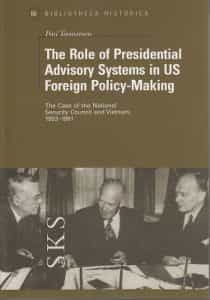
The Role of Presidential Advisory Systems in US Foreign Policy-Making
A veil of secrecy has usually been drawn over issues concerning US national security. The departments and agencies responsible for advising the President of the United States on such matters are coordinated within the White House by the National Security Council (NSC). The extent to which the NSC has been used has depended upon each individual Chief Executive. President Dwight D. Eisenhower in particular relied heavily on the NSC as his top forum for foreign policy discussions and debates.
Through close examination of Eisenhower's Vietnam policy-making, Pasi Tuunainen presents an analysis of the functioning of the President's NSC machinery as an advisory system. Tuunainen's work builds primarily upon extensive declassified archival materials and a massive body of literature. He rebuts the traditional criticism that Eisenhower's NSC machinery was merely a slow and toilsome "paper mill" which produced consensus recommendations and Policy Papers for long-term consumption. Tuunainen reveals instead that, regardless of it's red-tapism during the Eisenhower Administration (1953-1961), the formalized NSC think tank mechanism operated with considerable efficiency and flexibility, providing the President with a wide range of options and even adapting to acute situations.
However, interdepartmental and interagency coordination under the aegis of the NSC was complicated to some extent because Council members sometimes also acted in the interests of their respective departments and agencies, and their interpersonal relationships were further affected by various bureaucratic and civil-military rivalries. The case of Vietnam is particularly revealing. With the Council deliberating Vietnam-related issues at on in five of its regular weekly meetings "on top of policy hill", the American involvement in the fate of Vietnam progressively deepened.
Tuunainen's detailed study offers numerous insights into the inner workings and foreign policy decision-making processes of the Eisenhower Administration. At the same time, this is also an account of the Presidential NSC advisers - those business executives, lawyers and soldiers who assisted Eisenhower in coping with the Cold War crises of the 1950s.